
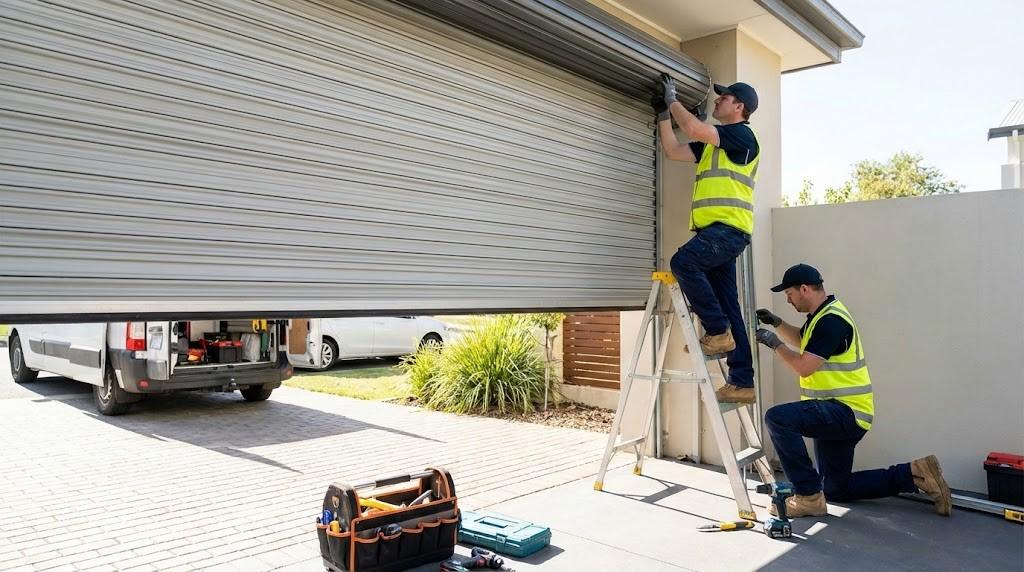
We install the roller shutter doors we manufacture, using our own teams. On a Benoni site that matters more than it sounds. When installation is subcontracted to whoever is nearest, nobody owns the result, and the warranty conversation a year later becomes an argument about whose fault it was.
How a roller shutter door installation runs
- Site survey. We measure the opening, check headroom and side room, and look at the structure the guides will fix to.
- Specification and quote. Door, drive, coating, safety devices and any structural work, priced as separate lines.
- Manufacture. Built to the measured opening, assembled and cycled in the workshop.
- Installation. Guides plumbed, barrel levelled, curtain tracked, drive set and tested.
- Handover. Operation, manual release and maintenance explained to whoever will use it.
Installing into older Apex industrial structure
Many Apex and Benoni South openings are framed in steel that has been in service for decades and, in a humid town, has lost section at the base of the guides. We assess what the guides are going to bolt to and quote the steel repair separately rather than hanging a new door on something that is going.
Installations on smallholdings and stable yards
On the plots around Benoni Small Farms, Brentwood Park and Putfontein the openings are wide, the ground is uneven and the supply is often a long single-phase run. We survey the threshold, the span and the power together, and we plan the work around the yard’s routine so a stable block is not standing open at feeding time.
Shopfront and retail installations
Fit-out work at Lakeside Mall, Northmead, Lakefield Square and the CBD strips is done inside the centre’s permitted hours, usually at night. We plan around the centre rules and trading times, because a shop that cannot open loses more in a morning than the door costs.
Residential roller shutter door installation
Homes through Rynfield, Farrarmere, Morehill, Lakefield and Crystal Park mostly want security shutters over patios, stacking doors, garages and side entrances. Those are neat installs: cable runs hidden, boxes sized to the reveal, finishes chosen to sit with the house rather than against it.
Thresholds on low-lying stands
On the streets closest to the lakes and dams the ground holds water after a storm. We set the threshold and specify the bottom seal for that rather than fitting a dry-site detail and leaving the owner to discover the difference in February.
Replacing an existing roller shutter door
We remove and dispose of the old door, correct the fixing points, and build the new door to the opening as it actually is. Openings move over decades, and a door built to the original drawing will not fit.
Installation lead times in Benoni
Standard galvanised doors run two to three weeks from approved measurements. Heavier coatings, fire-rated units and special finishes take longer, and we give the real date rather than the hopeful one.
Common questions
About roller shutter door installation
A single standard door is usually a one-day fit. Multiple bays are phased so you never lose more than part of your dock or workshop capacity at once. The longer part is manufacture — roughly two to three weeks from accepted quote.
No. Our own teams install what we manufacture. It matters more than it sounds: when installation is subcontracted to whoever is nearest, nobody owns the result, and the warranty conversation a year later becomes an argument about whose fault it was.
A structurally sound opening and, for motorised doors, a power supply at the right side of it. The site survey checks both. If the opening needs steelwork or the power needs moving, that is itemised in the quote rather than discovered on installation day.
Yes, and it is included in most replacement quotes. Say so at survey stage so the team arrives with the right equipment, particularly on wide industrial openings.
Related
Also worth a look
Roller Shutter Door Manufacturing
Wide shed openings built to measure
Plot sheds and workshops rarely match a catalogue size. Every Benoni door is built to the opening we measure, including the wide implement bays.
Read more about Roller Shutter Door ManufacturingGarage Door Repairs
Domestic and complex, all makes
Garage door repairs on roll-up, sectional and tip-up doors. Broken springs, doors that will not close, motors that hum but do not move —…
Read more about Garage Door RepairsRoller Shutter Door Spares and Replacement Parts
Springs, motors, slats, tracks
Springs, motors, slats, guide rails and remotes for roller shutter doors of all common makes. Where a door is worth saving, we repair rather…
Read more about Roller Shutter Door Spares and Replacement Parts